
AI Podcasting Tools in 2026: How Businesses Are Producing and Repurposing Audio Content More Efficiently
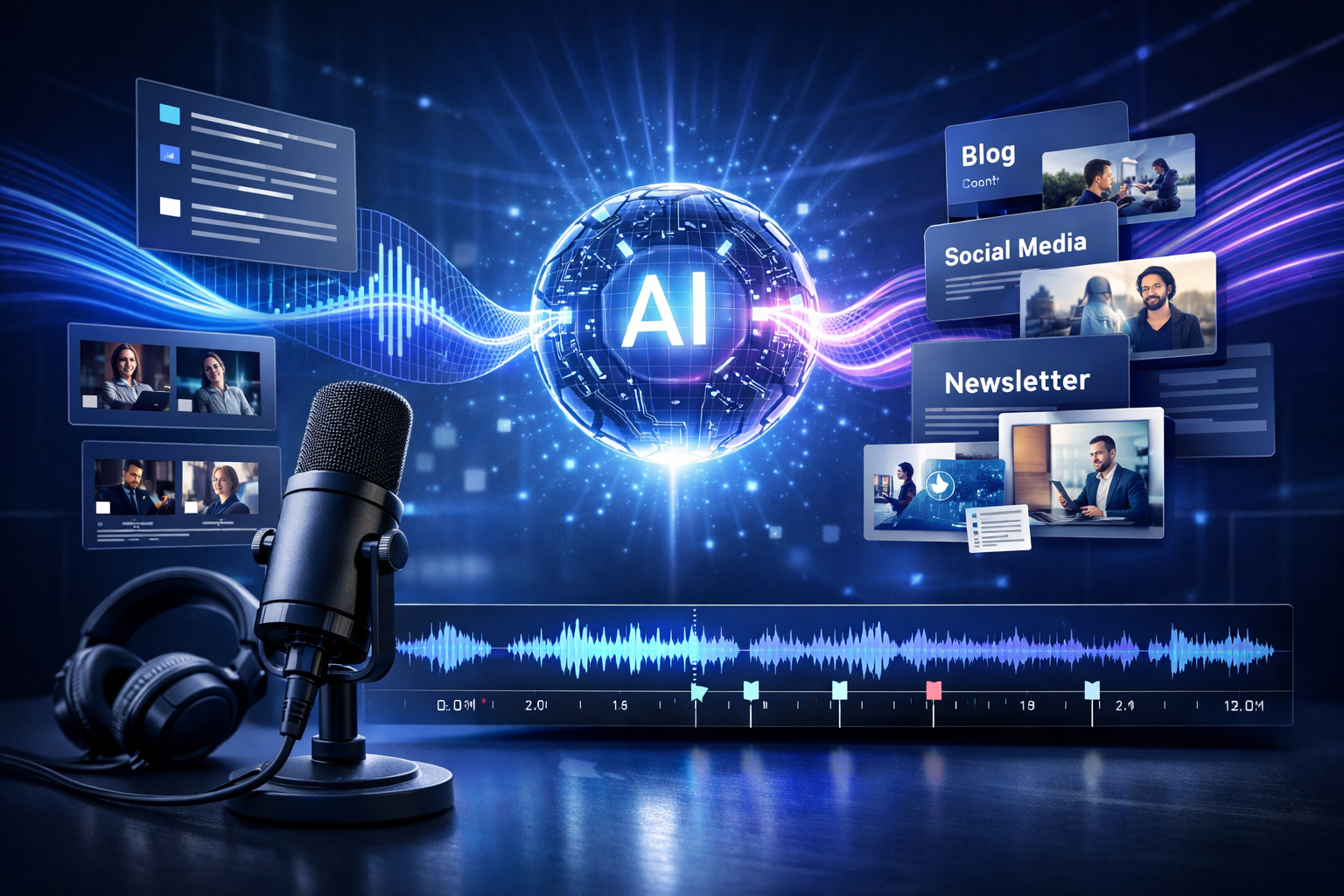
Podcasting has become an important way for businesses to build authority, educate audiences, share expertise, develop relationships, and create long-form content that can be reused across many channels.
But podcast production takes work.
A business needs to plan topics, record conversations, edit audio, remove mistakes, create show notes, write descriptions, generate transcripts, produce clips, publish episodes, and promote the content. For many companies, the biggest challenge is not having ideas. The challenge is turning those ideas into consistent, polished episodes.
AI podcasting tools are changing that.
Instead of relying only on manual editing, traditional recording software, transcription services, and time-consuming post-production workflows, businesses can now use AI to clean up audio, edit recordings, generate transcripts, create summaries, write show notes, identify clips, produce social posts, and repurpose podcast content into blogs, newsletters, and videos.
These tools are not replacing thoughtful hosts, strong conversations, editorial direction, or audience strategy. But AI is changing how businesses produce and distribute podcast content.
For companies that want to use podcasting as part of their content, brand, or thought leadership strategy, AI podcasting tools have become one of the most practical applications of artificial intelligence.
What AI Podcasting Tools Do
AI podcasting tools help businesses record, edit, summarize, publish, and repurpose podcast content using artificial intelligence.
At a basic level, these platforms can transcribe a recording and help turn it into usable assets. A business might upload a podcast episode and use AI to generate a transcript, summary, title options, show notes, social posts, blog drafts, or short promotional clips.
Many AI podcasting platforms include features such as:
- Audio recording
- Audio cleanup
- Background noise removal
- AI editing
- Transcript generation
- Speaker identification
- Filler word removal
- Show note generation
- Episode summaries
- Title suggestions
- Clip identification
- Short-form video creation
- Social post generation
- Blog post repurposing
- Newsletter repurposing
- Podcast publishing support
- Guest research
- Interview question generation
- Translation and dubbing
- Analytics and promotion support
The strongest platforms are not just audio editors. They are podcast production systems. They help businesses turn one recorded conversation into many useful content assets.
For example, a professional services firm might record a monthly podcast and use AI to create blog posts and LinkedIn content from each episode. A software company might use a podcast to interview customers and turn those conversations into case study material. A nonprofit might use podcast clips to support outreach. A consultant might use AI podcasting tools to turn expert interviews into newsletters, short videos, and educational content.
The real value is not simply that AI can edit audio. The value is that businesses can get more content and more reach from every recorded conversation.
How Podcast Production Worked Before AI
Before the rise of AI podcasting tools, producing a podcast often required several manual steps.
A team would plan an episode, record the conversation, edit the audio, remove mistakes, level sound, write the episode title, prepare show notes, create a transcript, design promotional graphics, publish the episode, and then promote it across email and social media.
For businesses without a dedicated media team, this could be a lot to manage.
Software helped, but it did not fully solve the problem.
Businesses used recording tools, audio editors, hosting platforms, transcription services, project management tools, design platforms, and social media schedulers. These tools supported podcast production, but they still required manual effort and coordination.
Someone still had to edit the recording. Someone still had to write the show notes. Someone still had to create the transcript. Someone still had to find the best clips. Someone still had to promote the episode. Someone still had to repurpose the content.
That meant many business podcasts started with enthusiasm but struggled with consistency.
The AI revolution changed the workflow. Instead of treating each episode as a large production burden, businesses can now use AI to speed up post-production and content repurposing.
What Changed With AI Podcasting
The biggest change is that AI podcasting tools reduce the effort required after recording.
A business can now record a conversation and quickly generate the materials needed to publish and promote it. AI can clean the audio, create transcripts, summarize the episode, identify key moments, and turn the discussion into multiple content formats.
That creates several important shifts.
First, editing becomes faster. AI can remove noise, improve audio quality, and help clean up recordings.
Second, publishing becomes easier. AI can generate titles, summaries, and show notes.
Third, repurposing becomes more practical. A podcast episode can become a blog post, social clips, newsletter content, quotes, and short videos.
Fourth, podcasting becomes more accessible. Businesses that do not have full production teams can still create professional audio content.
This is why AI podcasting tools are especially useful for businesses that use content marketing, thought leadership, interviews, executive visibility, training, education, or community building.
Practical Business Advantages
AI podcasting tools offer several practical advantages for businesses.
Faster Episode Production
The most obvious benefit is speed.
AI tools can reduce the time required to edit, transcribe, summarize, and prepare episodes for publication. This makes it easier for businesses to maintain a consistent podcast schedule.
Consistency matters because audiences are more likely to engage when episodes are published regularly.
Better Audio Quality
Not every business records in a professional studio.
AI tools can remove background noise, improve voice clarity, level audio, and clean up recordings. This helps make episodes sound more professional, even when recorded remotely.
Good audio quality can make the difference between a podcast that feels credible and one that feels difficult to listen to.
Easier Content Repurposing
A podcast is more than one audio file.
A single episode can become many pieces of content:
- A blog post
- A newsletter
- LinkedIn posts
- Short video clips
- Quote graphics
- Email content
- Website content
- Sales enablement material
- Internal training notes
AI tools make this repurposing much easier.
Stronger Thought Leadership
Podcasting gives businesses a way to share expertise in a conversational format.
AI tools help turn those conversations into searchable, shareable written content. This can support SEO, social media, executive visibility, and customer education.
Better Guest and Interview Workflows
Many business podcasts depend on interviews.
AI can help research guests, generate interview questions, summarize guest backgrounds, and create follow-up content after the episode. This can make the interview process smoother.
More Efficient Promotion
Publishing an episode is only part of the work.
AI podcasting tools can help create promotional posts, episode descriptions, email blurbs, social captions, and clips that make it easier to distribute each episode across channels.
Common Use Cases for AI Podcasting Tools
AI podcasting tools are being used across many business and content workflows.
Common use cases include:
- Podcast recording
- Audio cleanup
- Podcast editing
- Transcript generation
- Show note writing
- Episode summaries
- Title generation
- Clip creation
- Short-form video production
- Social media promotion
- Blog post repurposing
- Newsletter repurposing
- Guest research
- Interview question creation
- Speaker identification
- Filler word removal
- Podcast publishing support
- Translation and dubbing
- Thought leadership content
- Internal training content
The best use cases are usually content-heavy. If a business records conversations, interviews, webinars, or educational audio, AI podcasting tools can help turn that content into more usable assets.
What Businesses Should Look For in an AI Podcasting Platform
Not all AI podcasting tools are the same. Some focus on recording. Others focus on editing, transcripts, clips, publishing, content repurposing, or promotion.
When comparing providers, businesses should look at:
- Audio quality enhancement
- Editing features
- Transcription accuracy
- Speaker identification
- Show note quality
- Clip generation
- Video support
- Publishing integrations
- Social media export options
- Blog and newsletter repurposing
- Collaboration features
- Team permissions
- Brand voice controls
- Translation and dubbing support
- Storage limits
- Export formats
- Ease of use
- Pricing structure
- Professional or enterprise support
Businesses should also consider content ownership and usage rights. Podcasts often include original conversations, guest content, and business-sensitive discussions, so privacy and permissions matter.
Where AI Podcasting Fits in the Future of Business Content
AI podcasting tools are becoming part of the modern content marketing stack.
In 2026, businesses are likely to use AI to produce episodes faster, improve audio quality, create transcripts, generate promotional materials, and repurpose conversations across many channels.
But the companies that benefit most will not be the ones that treat AI as a substitute for substance. They will be the ones that use AI to amplify useful conversations and expert thinking.
They will use AI to reduce production friction. They will use AI to turn conversations into written content. They will use AI to create clips and promotional assets. They will use AI to support consistent publishing. They will use AI to get more value from every episode.
That is where the real business value is.
Final Thoughts
AI podcasting tools are helping businesses move beyond the old limits of manual editing and time-consuming content repurposing. They make it easier to record, clean up, transcribe, publish, promote, and reuse podcast content.
The value is not just faster production. The value is making podcasting more practical as a business content strategy.
Businesses need to share expertise. They need to build trust. They need to educate audiences. They need to create reusable content. They need to stay visible across channels. They need to make long-form conversations easier to produce and promote.
AI podcasting platforms help make that possible.
That is why this category has become one of the most important areas of practical AI adoption for thought leadership, content marketing, and business media.
Keep reading
- AI Education & Training ToolsPluralsight Introduces AI Learning Integrations and Skill Development Tools
- AI Cybersecurity ToolsSecuronix Introduces Agent Behavioral Analytics to Monitor Autonomous Systems
- AI Healthcare Technology ToolsGenie Health Secures Seed Capital to Expand AI-Driven Digital Healthcare Solutions
- AI Coding & Developer ToolsSimplismart In Talks for New Investment Round to Expand AI Infrastructure
- AI Research ToolsAlbert Invent Advances AI for Chemical Experimentation
- AI Cybersecurity ToolsSophos Introduces AI Defense for Real-Time Security and Shadow AI Detection