
AI Website Builders in 2026: How Businesses Are Creating and Launching Websites Faster
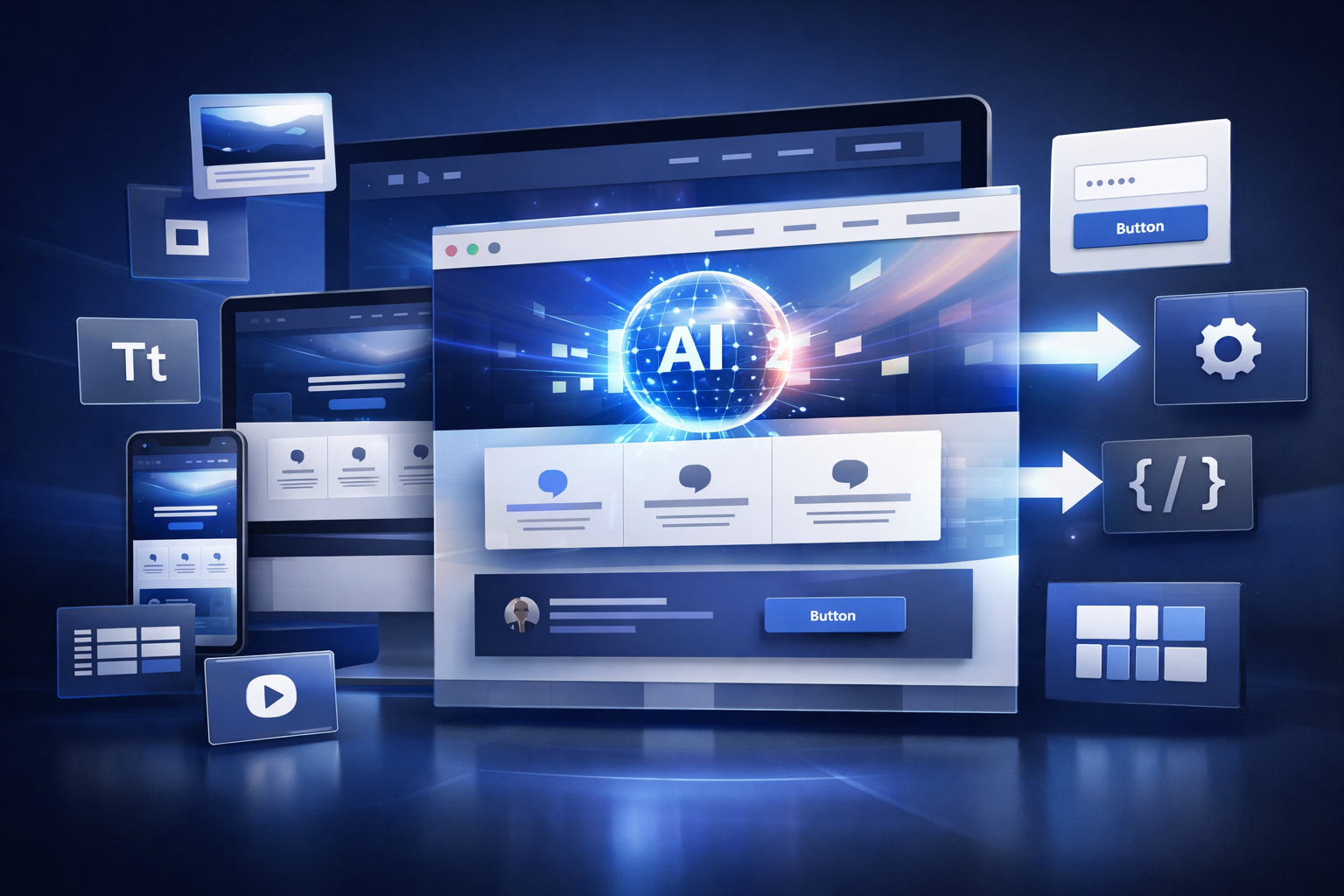
A website is still one of the most important digital assets a business can own. Companies use websites to explain what they do, generate leads, sell products, publish content, showcase credibility, support customers, and control their online presence.
But building a website has traditionally required time, planning, design, copywriting, development, hosting, testing, and ongoing updates.
For many small businesses and startups, launching a site can feel overwhelming. For larger organizations, updating pages can require design requests, developer time, content approvals, and technical coordination. Even simple changes can take longer than expected.
AI website builders are changing that.
Instead of relying only on manual design, traditional templates, drag-and-drop editors, and developer-heavy workflows, businesses can now use AI to generate page layouts, write website copy, create design directions, suggest sections, build landing pages, optimize content, and launch websites faster.
These tools are not replacing web strategy, brand development, technical quality, or human review. A strong website still needs clear positioning, useful content, credible design, clean navigation, and a real understanding of the audience. But AI is changing how businesses move from idea to published site.
For companies that need to launch faster, test ideas, build landing pages, or reduce website development bottlenecks, AI website builders have become one of the most practical applications of artificial intelligence.
What AI Website Builders Do
AI website builders help businesses create, design, write, and launch websites using artificial intelligence.
At a basic level, these platforms can generate a website based on a prompt or a short business description. A user might describe the business, audience, services, brand style, and goals, and the AI tool can create page sections, draft copy, suggest imagery, and generate a site structure.
Many AI website builders include features such as:
- AI-generated website layouts
- Homepage creation
- Landing page creation
- Website copy generation
- Service page drafting
- Blog page support
- Contact forms
- Navigation structure
- Brand style suggestions
- Image and icon suggestions
- SEO title and meta description support
- Mobile-responsive design
- E-commerce support
- Lead capture forms
- Template customization
- Content editing
- Hosting support
- Domain connection
- Analytics integration
- Conversion optimization suggestions
The strongest platforms are not just template generators. They are website creation systems. They help businesses move from concept to usable website faster.
For example, a startup might use an AI website builder to create a first version of its site before raising funding. A local business might use AI to launch a professional homepage and service pages. A marketing team might create campaign landing pages quickly. A founder might test a new business idea with a simple site. An agency might use AI to speed up first drafts for client websites.
The real value is not simply that AI can generate a page. The value is that businesses can reduce the time and friction between having an idea and having a live web presence.
How Websites Used to Be Built Before AI
Before the rise of AI website builders, building a website usually followed a more manual process.
A business would define its pages, write copy, choose a design direction, select a platform, build layouts, add images, configure forms, test mobile responsiveness, connect a domain, and publish the site. Depending on the complexity, the work might involve a designer, developer, copywriter, SEO specialist, photographer, project manager, and business owner.
For high-value websites, that level of process can still be appropriate. A complex brand site, e-commerce platform, SaaS product, marketplace, or custom application may need professional design and development.
But many businesses need simpler websites, landing pages, and campaign pages that can be built faster.
Software helped, but it did not fully solve the problem.
Businesses used website builders, WordPress themes, page builders, hosting platforms, template libraries, design tools, CMS platforms, and landing page builders. These tools made website creation more accessible, but they still required time and decision-making.
Someone still had to write the copy. Someone still had to choose the layout. Someone still had to organize the pages. Someone still had to design the sections. Someone still had to optimize the content. Someone still had to launch and update the site.
That meant website creation could still become a bottleneck.
The AI revolution changed the workflow. Instead of starting every site from a blank page or generic template, businesses can now start with AI-generated structure, copy, and design direction.
What Changed With AI Website Builders
The biggest change is that AI website builders reduce the time between business concept and working website.
A business user can describe what they need, and the AI can generate an initial site structure, page sections, headlines, body copy, calls to action, and design direction. From there, the user can edit, refine, and publish.
That creates several important shifts.
First, websites become faster to launch. Businesses can get a first version live without weeks of planning and production.
Second, content creation becomes easier. AI can help draft homepage copy, service descriptions, landing page sections, FAQs, and calls to action.
Third, testing becomes more practical. Businesses can launch landing pages, campaign pages, and new service pages faster to see what works.
Fourth, non-technical users gain more control. Founders, marketers, and small business owners can create usable web pages without relying on developers for every step.
This is why AI website builders are especially useful for startups, small businesses, marketing teams, agencies, creators, consultants, local service providers, and companies that need to move quickly.
Practical Business Advantages
AI website builders offer several practical advantages for businesses.
Faster Website Launches
The most obvious benefit is speed.
AI website builders can help businesses create a homepage, service pages, landing pages, and basic content much faster than traditional workflows. This is especially useful when a company needs a credible site quickly.
A first version does not need to be perfect. It needs to be clear, functional, and easy to improve.
Lower Initial Build Costs
Traditional website development can be expensive, especially for small businesses and early-stage startups.
AI website builders can reduce initial costs by generating layouts, copy, and structure quickly. Businesses may still hire professionals later for deeper branding, custom development, SEO, or conversion optimization, but AI can make the first version more affordable.
Easier Landing Page Creation
Marketing teams often need landing pages for campaigns, offers, ads, webinars, events, and lead magnets.
AI website builders can help create these pages quickly. This makes campaign testing and lead generation more flexible.
Better Support for Non-Technical Users
Many business owners and marketers want to update their websites without waiting for developers.
AI website builders can make it easier to create and edit pages, update copy, add sections, and experiment with messaging.
This can reduce bottlenecks and keep websites more current.
Faster Copy and Messaging Drafts
Website copy is often one of the hardest parts of launching a site.
AI can help create first drafts for headlines, service descriptions, FAQs, calls to action, about pages, and product explanations. These drafts still need human refinement, but they help businesses get past the blank page.
More Rapid Testing of Business Ideas
AI website builders make it easier to test new concepts.
A business can create a landing page for a new service, product, offer, or market segment without committing to a full website build. This can help validate interest before investing more heavily.
Common Use Cases for AI Website Builders
AI website builders are being used across many business needs.
Common use cases include:
- Small business websites
- Startup landing pages
- Service business websites
- Campaign landing pages
- Product launch pages
- Event pages
- Consultant websites
- Agency client drafts
- Creator websites
- Portfolio sites
- Local business sites
- Lead generation pages
- E-commerce starter sites
- Blog setup
- About pages
- Contact pages
- FAQ sections
- SEO page drafts
- Website redesign drafts
- New business idea testing
The best use cases are usually situations where speed, clarity, and ease of launch matter more than deep custom development.
What Businesses Should Look For in an AI Website Builder
Not all AI website builders are the same. Some focus on simple websites. Others focus on landing pages, e-commerce, design flexibility, SEO, custom code, hosting, or CMS functionality.
When comparing providers, businesses should look at:
- Design quality
- Ease of editing
- Mobile responsiveness
- SEO controls
- Website copy generation
- Page structure generation
- Form and lead capture support
- Domain connection
- Hosting options
- E-commerce features
- Blog or CMS support
- Analytics integration
- Conversion optimization features
- Custom code access
- Export options
- Brand customization
- Security features
- Pricing structure
- Support options
Businesses should also think about portability. A site that launches quickly is helpful, but companies should understand whether they can export, migrate, or expand the site later.
Where AI Website Builders Fit in the Future of Web Development
AI website builders are becoming part of the modern web creation stack.
In 2026, businesses are likely to use AI to create first drafts, launch landing pages, test offers, generate content, and speed up early-stage web design. Traditional designers and developers will still be important for complex, highly customized, or deeply strategic websites.
The companies that benefit most will not be the ones that publish generic AI-generated websites without editing. They will be the ones that use AI to move faster while still refining the message, design, and user experience.
They will use AI to launch faster. They will use AI to test ideas. They will use AI to draft web copy. They will use AI to create landing pages. They will use AI to reduce bottlenecks while keeping control over brand and strategy.
That is where the real business value is.
Final Thoughts
AI website builders are helping businesses move beyond the old limits of slow website creation, blank-page copywriting, and developer-dependent updates. They make it easier to create websites, landing pages, campaign pages, and content drafts quickly.
The value is not just faster web design. The value is faster digital presence.
Businesses need to explain what they do. They need to generate leads. They need to launch campaigns. They need to test offers. They need to update content. They need to create trust before customers contact them.
AI website builder platforms help make that possible.
That is why this category has become one of the most important areas of practical AI adoption for startups, small businesses, marketers, agencies, and companies that need to move quickly online.
Stand up a credible marketing site, structure the pages, and fill them with usable copy and imagery without hiring an agency first.
Keep reading
- AI Education & Training ToolsPluralsight Introduces AI Learning Integrations and Skill Development Tools
- AI Cybersecurity ToolsSecuronix Introduces Agent Behavioral Analytics to Monitor Autonomous Systems
- AI Healthcare Technology ToolsGenie Health Secures Seed Capital to Expand AI-Driven Digital Healthcare Solutions
- AI Coding & Developer ToolsSimplismart In Talks for New Investment Round to Expand AI Infrastructure
- AI Research ToolsAlbert Invent Advances AI for Chemical Experimentation
- AI Cybersecurity ToolsSophos Introduces AI Defense for Real-Time Security and Shadow AI Detection