
AI HR and Recruiting Tools in 2026: How Businesses Are Hiring and Managing Talent More Efficiently
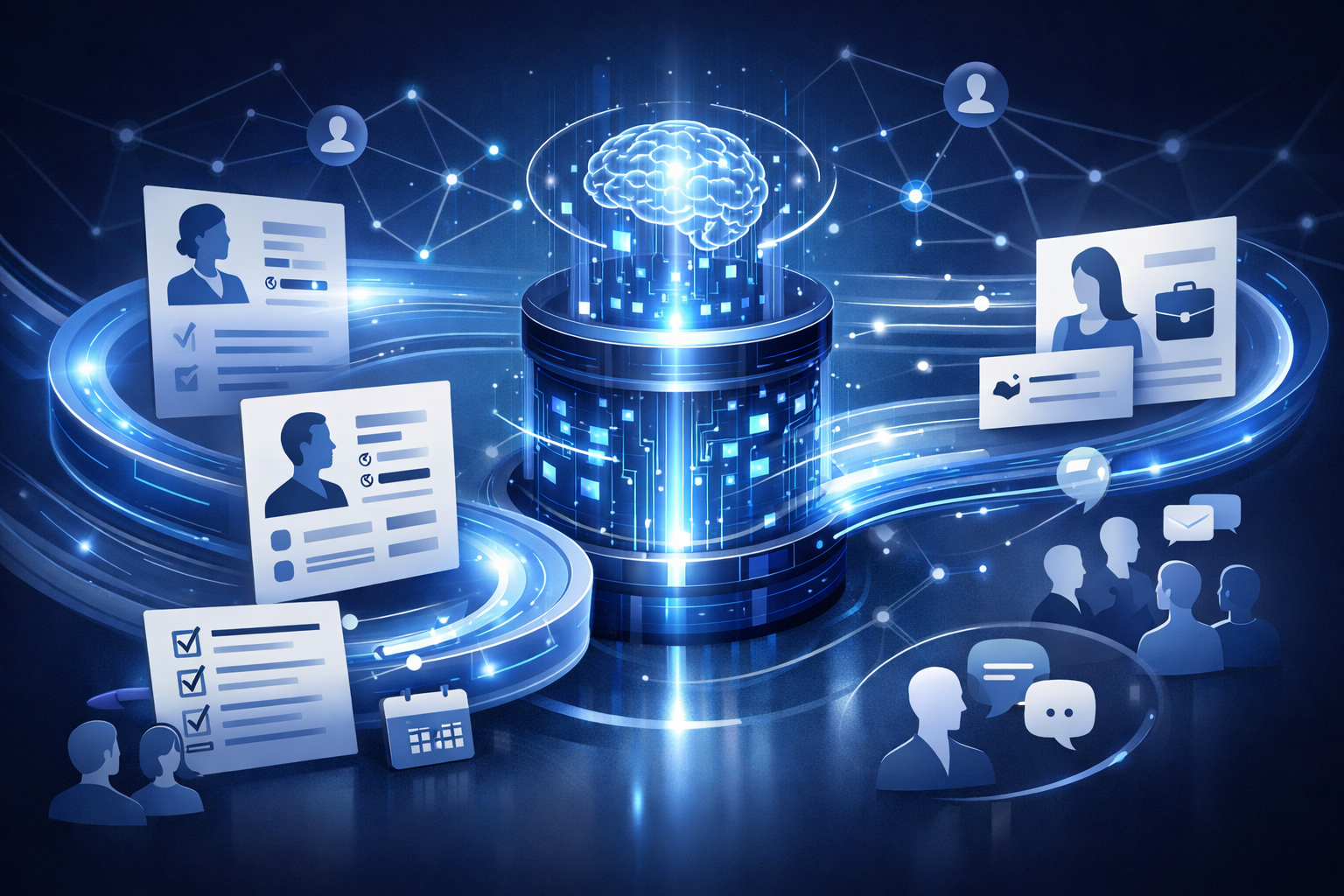
People are one of the most important parts of any business. Companies need to attract candidates, evaluate applicants, schedule interviews, onboard employees, manage performance, support managers, answer HR questions, and keep teams engaged.
But HR and recruiting work can be difficult to manage at scale.
Recruiters may review hundreds of resumes. Hiring managers may struggle to compare candidates consistently. HR teams are often asked the same policy questions repeatedly. Employee onboarding can become fragmented. And as companies grow, people operations can become increasingly administrative.
AI HR and recruiting tools are changing that.
Instead of relying only on manual resume review, traditional applicant tracking systems, static HR portals, and repetitive administrative workflows, businesses can now use AI to screen candidates, summarize resumes, draft job descriptions, support interview planning, answer employee questions, analyze workforce trends, and automate routine HR tasks.
These tools are not replacing HR professionals or recruiters. Hiring and people management require judgment, fairness, empathy, culture awareness, and human decision-making. But AI is changing how HR teams manage repetitive work and make people processes more efficient.
For companies that need better hiring workflows, faster recruiting support, and more scalable HR operations, AI HR and recruiting tools have become one of the most practical applications of artificial intelligence.
What AI HR and Recruiting Tools Do
AI HR and recruiting tools help businesses manage hiring, employee support, and people operations using artificial intelligence.
At a basic level, these platforms can help with job descriptions, candidate screening, resume summaries, interview scheduling, employee questions, onboarding content, performance review support, and HR workflow automation.
Many AI HR and recruiting platforms include features such as:
- Job description generation
- Resume screening
- Candidate matching
- Applicant ranking support
- Interview question generation
- Interview scheduling
- Candidate communication
- Recruiting chatbots
- Employee onboarding support
- HR policy Q&A
- Performance review assistance
- Employee engagement analysis
- Workforce analytics
- Skills assessment
- Internal mobility support
- Learning recommendations
- Compliance support
- Offer letter drafting
- Benefits question support
- HR workflow automation
The strongest platforms are not just resume scanners. They are people operations systems. They help HR teams reduce administrative work while improving consistency across hiring and employee support.
For example, a recruiter might use AI to summarize applicant qualifications. A hiring manager might use AI to create structured interview questions. An HR team might use an internal chatbot to answer common employee policy questions. A growing company might use AI to improve onboarding workflows. A leadership team might use AI to analyze employee engagement data or workforce trends.
The real value is not simply that AI can sort resumes or draft job posts. The value is that HR teams can spend more time on people and less time on repetitive administration.
How HR and Recruiting Used to Work Before AI
Before the rise of AI HR tools, recruiting and people operations were heavily manual.
A recruiter would write a job description, post it across job boards, review resumes, identify qualified candidates, schedule interviews, coordinate with hiring managers, communicate with applicants, and track everything in an applicant tracking system.
HR teams handled onboarding, employee questions, policy updates, benefits information, performance cycles, training records, and compliance tasks through a mix of HR software, documents, email, spreadsheets, and internal portals.
Software helped, but it did not fully solve the problem.
Businesses used applicant tracking systems, HRIS platforms, job boards, scheduling tools, payroll systems, document libraries, learning platforms, and employee survey tools. These systems helped organize the work, but they still required significant manual effort.
Someone still had to review resumes. Someone still had to schedule interviews. Someone still had to answer repeat HR questions. Someone still had to create onboarding materials. Someone still had to summarize employee feedback. Someone still had to coordinate the hiring process.
That meant HR teams could become overloaded as companies grew.
The AI revolution changed the workflow. Instead of requiring every HR and recruiting task to be handled manually, AI tools can help summarize, automate, draft, organize, and prioritize the work.
What Changed With AI HR and Recruiting
The biggest change is that AI helps HR teams manage high-volume, repeatable processes more efficiently.
A recruiter can now use AI to summarize resumes, compare candidate qualifications, draft outreach, and prepare interview questions. An HR team can use AI to answer policy questions, generate onboarding materials, and analyze employee trends.
That creates several important shifts.
First, recruiting becomes faster. Teams can review large applicant pools more efficiently and move qualified candidates through the process sooner.
Second, candidate communication becomes easier. AI can help draft messages, schedule interviews, and keep applicants informed.
Third, HR support becomes more scalable. Employees can get answers to common questions without waiting for an HR team member.
Fourth, workforce insights become easier to access. AI can help summarize survey results, identify trends, and support people planning.
This is why AI HR and recruiting tools are especially useful for growing companies, high-volume hiring teams, distributed workforces, and HR departments managing many repeatable tasks.
Practical Business Advantages
AI HR and recruiting tools offer several practical advantages for businesses.
Faster Candidate Screening
The most obvious benefit is speed.
Recruiters often receive more applications than they can review quickly. AI tools can help summarize resumes, identify relevant experience, compare qualifications, and highlight candidates who may match the role.
This does not mean AI should make final hiring decisions. It means recruiters can use AI to organize and review information more efficiently.
Better Job Descriptions and Candidate Communication
AI can help create clearer job descriptions, outreach messages, interview invitations, rejection notices, and candidate follow-ups.
This can improve communication consistency and reduce the time recruiters spend writing repetitive messages.
Good candidate communication matters because the hiring process reflects the company’s brand.
More Structured Interviewing
AI tools can help hiring teams create interview questions tied to job requirements, skills, experience, and competencies.
Structured interviews can make candidate evaluation more consistent and reduce the risk of decisions being based on informal impressions alone.
Human judgment still matters, but AI can help create a better framework for evaluation.
Improved Employee Self-Service
HR teams often answer the same questions about benefits, policies, time off, payroll, onboarding, and company procedures.
AI HR assistants can answer common questions based on approved internal documents. This helps employees get faster answers and reduces repetitive work for HR teams.
More Efficient Onboarding
Onboarding requires documents, training materials, introductions, checklists, policy explanations, and role-specific information.
AI tools can help create onboarding plans, answer new employee questions, summarize company policies, and guide employees through early steps.
This can make onboarding more consistent and less overwhelming.
Better Workforce Insights
AI can help analyze employee surveys, performance trends, engagement data, skills gaps, and workforce planning information.
This can help leaders understand where teams may need support, where training is needed, or where retention risks may be emerging.
Common Use Cases for AI HR and Recruiting Tools
AI HR and recruiting tools are being used across many people operations functions.
Common use cases include:
- Resume screening
- Candidate matching
- Job description writing
- Recruiting outreach
- Interview scheduling
- Interview question generation
- Candidate summaries
- Applicant tracking support
- Employee onboarding
- HR policy Q&A
- Benefits questions
- Performance review drafting
- Employee engagement analysis
- Workforce analytics
- Skills assessment
- Internal mobility
- Learning recommendations
- Offer letter support
- Compliance documentation
- HR workflow automation
The best use cases are usually repetitive, high-volume, or information-heavy. AI tools work best when they help HR teams process information more efficiently while preserving human oversight.
What Businesses Should Look For in an AI HR or Recruiting Platform
Not all AI HR tools are the same. Some focus on recruiting. Others focus on employee support, HR automation, engagement, workforce analytics, or performance management.
When comparing providers, businesses should look at:
- Applicant tracking integration
- Candidate screening transparency
- Bias mitigation features
- Compliance support
- Job description quality
- Interview workflow support
- Employee self-service features
- HRIS integration
- Data privacy controls
- Permission settings
- Auditability
- Candidate communication tools
- Reporting and analytics
- Onboarding support
- Team collaboration
- Ease of use
- Custom policy knowledge base
- Pricing structure
- Enterprise support
Businesses should be especially careful about fairness, transparency, and compliance. AI should support HR decision-making, not create hidden or unfair hiring processes.
Where AI HR and Recruiting Fits in the Future of People Operations
AI HR and recruiting tools are becoming part of the modern people operations stack.
In 2026, businesses are likely to use AI across recruiting, onboarding, employee support, engagement, performance workflows, and workforce planning. HR teams will still make the important people decisions, but AI will help manage the administrative and information-heavy parts of the work.
The companies that benefit most will not be the ones that try to remove people from HR. They will be the ones that use AI to make HR more responsive, consistent, and focused on higher-value work.
They will use AI to screen information faster. They will use AI to communicate more consistently. They will use AI to support employees with common questions. They will use AI to improve onboarding. They will use AI to help HR teams spend more time on people, not paperwork.
That is where the real business value is.
Final Thoughts
AI HR and recruiting tools are helping businesses move beyond the old limits of manual hiring and repetitive HR administration. They make it easier to review candidates, manage communication, support employees, improve onboarding, and understand workforce trends.
The value is not just faster hiring. The value is better people operations.
Businesses need to find qualified candidates. They need to communicate clearly. They need to support employees. They need to manage onboarding. They need to reduce repetitive HR work. They need to make people processes more consistent and fair.
AI HR and recruiting platforms help make that possible.
That is why this category has become one of the most important areas of practical AI adoption for growing organizations.
Move through applications faster and communicate better with candidates, while keeping hiring decisions with people and defensible.
Keep reading
- AI Education & Training ToolsPluralsight Introduces AI Learning Integrations and Skill Development Tools
- AI Cybersecurity ToolsSecuronix Introduces Agent Behavioral Analytics to Monitor Autonomous Systems
- AI Healthcare Technology ToolsGenie Health Secures Seed Capital to Expand AI-Driven Digital Healthcare Solutions
- AI Coding & Developer ToolsSimplismart In Talks for New Investment Round to Expand AI Infrastructure
- AI Research ToolsAlbert Invent Advances AI for Chemical Experimentation
- AI Cybersecurity ToolsSophos Introduces AI Defense for Real-Time Security and Shadow AI Detection