
AI Knowledge Management Tools in 2026: How Businesses Are Making Internal Information Easier to Find and Use
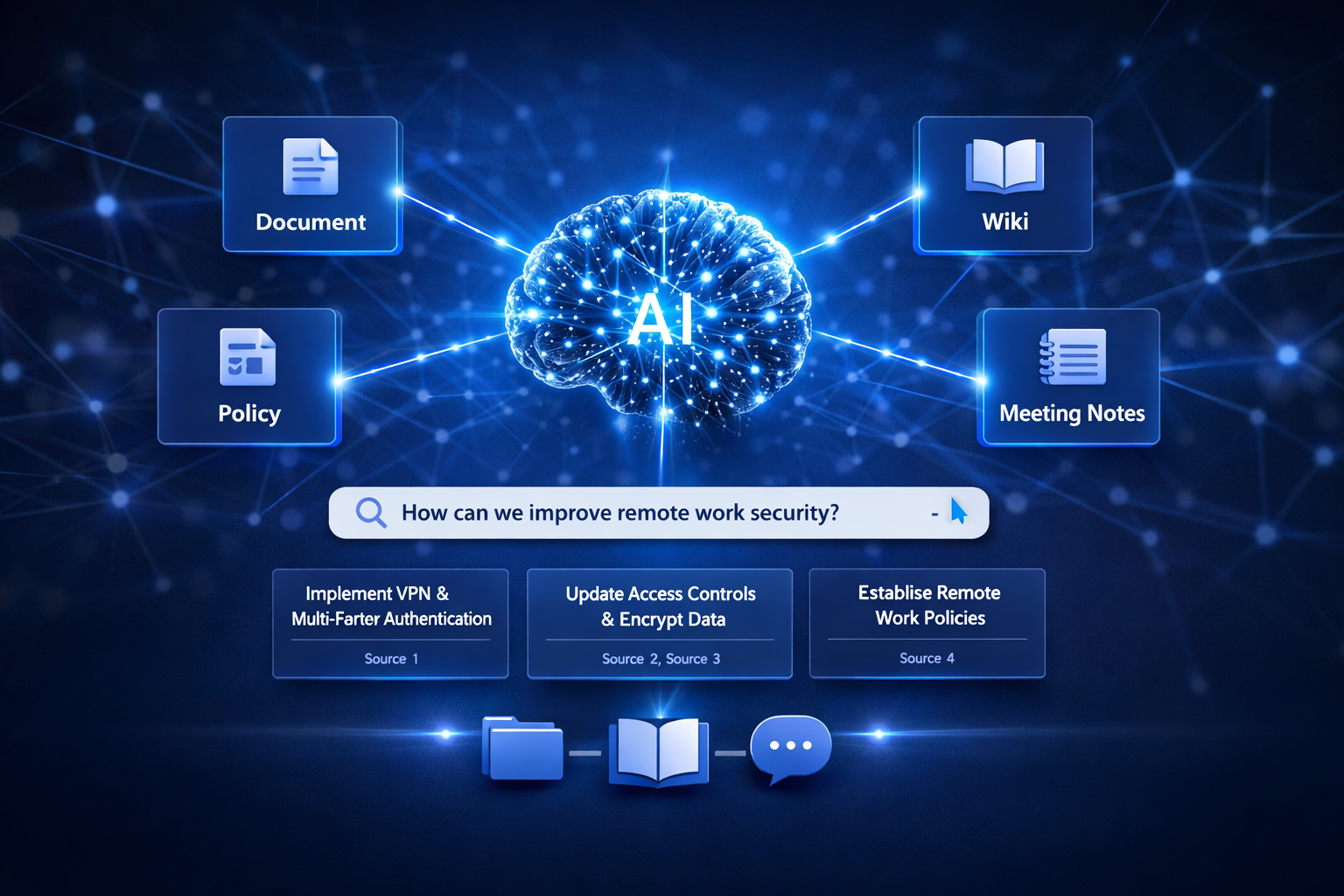
Knowledge is one of the most valuable assets in a business. Companies create information every day through documents, meetings, emails, customer conversations, project notes, policies, training materials, sales decks, product documentation, and internal processes.
But business knowledge is often hard to find.
Information gets scattered across shared drives, chat channels, CRMs, help desks, project management tools, wikis, PDFs, emails, and individual employees. Teams may repeat work because they cannot find what already exists. New employees may struggle to understand where information lives. Managers may not know whether employees are using the latest approved version of a document.
AI knowledge management tools are changing that.
Instead of relying only on static wikis, folder structures, search bars, and manual documentation, businesses can now use AI to search across internal knowledge, summarize documents, answer employee questions, recommend relevant materials, organize information, and turn scattered content into usable knowledge.
These tools are not replacing good documentation habits or internal communication. Companies still need accurate source material, ownership, review, and governance. But AI is changing how employees access and use organizational knowledge.
For businesses that need faster internal answers, better onboarding, and stronger information flow, AI knowledge management tools have become one of the most practical applications of artificial intelligence.
What AI Knowledge Management Tools Do
AI knowledge management tools help businesses organize, retrieve, summarize, and use internal information using artificial intelligence.
At a basic level, these platforms allow employees to ask questions and receive answers based on company-approved sources. Instead of searching through folders or asking a coworker, a user might ask:
- What is our refund policy?
- Where is the latest sales deck?
- How do we onboard a new client?
- What did we decide in the last project meeting?
- Which case studies are approved for healthcare prospects?
- What is the process for escalating a support issue?
The AI tool can search connected sources, summarize relevant information, and provide an answer with links back to the original documents.
Many AI knowledge management platforms include features such as:
- Internal knowledge search
- Document summarization
- Company Q&A
- Source-based answers
- Wiki support
- Policy retrieval
- Meeting knowledge capture
- Onboarding support
- Sales enablement search
- Support knowledge search
- Permission-aware answers
- Content recommendations
- Knowledge gap detection
- Document organization
- Version control support
- Team collaboration
- Workflow integration
- Employee self-service
- Search across apps
- Knowledge base analytics
The strongest platforms are not just search tools. They are internal knowledge systems. They help businesses turn scattered information into accessible, trusted answers.
For example, a sales team might use AI knowledge management to find approved case studies and messaging. A support team might use it to search troubleshooting documents. A new employee might use it to ask onboarding questions. A manager might use it to find past project decisions. An HR team might use it to answer common policy questions.
The real value is not simply that AI can search documents. The value is that employees can find the right information faster and with more confidence.
How Knowledge Management Worked Before AI
Before the rise of AI knowledge management tools, businesses relied on folders, wikis, intranets, shared drives, chat histories, and internal documentation.
Employees had to know where to look. They might search a folder, ask a coworker, scroll through chat messages, open a wiki page, or check old emails. If the information was outdated or duplicated, they had to figure out which version was correct.
Software helped, but it did not fully solve the problem.
Businesses used document storage platforms, intranets, project management systems, wikis, CRMs, help desks, learning systems, and chat tools. These systems stored information, but they did not always make it easy to find or understand.
Someone still had to know where the document was. Someone still had to search the right system. Someone still had to read through long files. Someone still had to verify the latest version. Someone still had to ask another employee for context. Someone still had to update outdated knowledge.
That meant internal knowledge was often underused.
The AI revolution changed the workflow. Instead of forcing employees to search through systems manually, AI knowledge tools can retrieve, summarize, and explain information from approved sources.
What Changed With AI Knowledge Management
The biggest change is that AI makes internal knowledge more conversational.
An employee can ask a question in plain language and receive an answer based on the company’s documents, policies, conversations, or knowledge base. This makes internal information easier to access, especially for employees who do not know where something is stored.
That creates several important shifts.
First, knowledge becomes easier to find. Employees can ask questions instead of navigating complex folder structures.
Second, long documents become more useful. AI can summarize policies, manuals, reports, meeting notes, and training materials.
Third, onboarding becomes faster. New employees can ask questions and find approved information without interrupting teammates.
Fourth, knowledge becomes more consistent. AI can point employees to approved sources instead of relying on informal memory or outdated versions.
This is why AI knowledge management tools are especially useful for growing companies, distributed teams, support organizations, sales teams, HR departments, professional services firms, and businesses with complex internal processes.
Practical Business Advantages
AI knowledge management tools offer several practical advantages for businesses.
Faster Internal Answers
The most obvious benefit is speed.
Employees can find information faster by asking questions instead of searching manually. This reduces wasted time and helps people complete work more efficiently.
Faster access to information can improve productivity across the organization.
Better Onboarding
New employees often have many questions.
AI knowledge tools can help new hires understand policies, processes, tools, products, and team workflows. This allows them to get answers without constantly interrupting managers or coworkers.
Better onboarding helps employees become productive faster.
More Consistent Information
When employees rely on memory or informal messages, answers can become inconsistent.
AI knowledge tools can provide answers based on approved documents and sources. This helps teams use the same policies, messaging, and procedures.
Consistency is especially important for sales, support, HR, compliance, and customer-facing teams.
Better Use of Existing Content
Most businesses already have valuable information stored somewhere.
AI tools make that content more useful by allowing employees to search, summarize, and retrieve it more easily. This helps companies get more value from documentation they have already created.
Reduced Repeated Questions
Managers, HR teams, IT teams, and support leaders often answer the same internal questions repeatedly.
AI knowledge tools can reduce repeated questions by giving employees a self-service way to find common answers.
Stronger Institutional Memory
Companies lose knowledge when employees leave or when information remains trapped in conversations.
AI knowledge tools can help capture and organize meeting notes, project decisions, customer insights, and internal documents so knowledge stays available to the organization.
Common Use Cases for AI Knowledge Management Tools
AI knowledge management tools are being used across many business functions.
Common use cases include:
- Internal company search
- Employee Q&A
- HR policy answers
- IT support knowledge
- Sales enablement
- Customer support knowledge
- Onboarding support
- Document summarization
- Meeting knowledge capture
- Project history search
- Process documentation
- Product knowledge retrieval
- Compliance knowledge access
- Training material search
- Case study retrieval
- Proposal support
- Knowledge base analytics
- Source-based answers
- Team documentation
- Internal wiki enhancement
The best use cases are usually information-heavy environments where employees need quick access to reliable internal knowledge.
What Businesses Should Look For in an AI Knowledge Management Platform
Not all AI knowledge management tools are the same. Some focus on internal search. Others focus on wikis, enterprise Q&A, document intelligence, support knowledge, or sales enablement.
When comparing providers, businesses should look at:
- Source-based answers
- Permission-aware search
- Document integrations
- Chat and collaboration integrations
- CRM integration
- Help desk integration
- Wiki support
- Summarization quality
- Search accuracy
- Version control support
- Data privacy controls
- Security standards
- Admin permissions
- Audit logs
- Knowledge gap detection
- User analytics
- Ease of updating content
- Mobile access
- Pricing structure
- Enterprise support
Businesses should also make sure the AI respects access permissions. Employees should only receive answers from documents and systems they are allowed to access.
Where AI Knowledge Management Fits in the Future of Work
AI knowledge management tools are becoming part of the modern workplace infrastructure.
In 2026, businesses are likely to use AI to make internal documents, policies, processes, meeting notes, and customer information easier to access. As organizations create more content and use more software systems, knowledge management will become even more important.
The companies that benefit most will not be the ones that simply connect AI to every document without structure. They will be the ones that build trusted knowledge systems with clear sources and ownership.
They will use AI to help employees find answers faster. They will use AI to make documents easier to use. They will use AI to improve onboarding. They will use AI to reduce repeated questions. They will use AI to preserve organizational knowledge.
That is where the real business value is.
Final Thoughts
AI knowledge management tools are helping businesses move beyond the old limits of scattered documents, static wikis, and hard-to-search internal systems. They make it easier to find information, summarize documents, answer employee questions, and preserve institutional knowledge.
The value is not just better search. The value is better access to what the company already knows.
Businesses need to onboard employees. They need to support teams. They need to preserve knowledge. They need to reduce repeated questions. They need to keep information consistent. They need to help employees find trusted answers quickly.
AI knowledge management platforms help make that possible.
That is why this category has become one of the most important areas of practical AI adoption for modern organizations.
Deflect repetitive tickets, draft accurate agent replies, and route the rest to the right person without degrading the customer experience.
Keep reading
- AI Education & Training ToolsPluralsight Introduces AI Learning Integrations and Skill Development Tools
- AI Cybersecurity ToolsSecuronix Introduces Agent Behavioral Analytics to Monitor Autonomous Systems
- AI Healthcare Technology ToolsGenie Health Secures Seed Capital to Expand AI-Driven Digital Healthcare Solutions
- AI Coding & Developer ToolsSimplismart In Talks for New Investment Round to Expand AI Infrastructure
- AI Research ToolsAlbert Invent Advances AI for Chemical Experimentation
- AI Cybersecurity ToolsSophos Introduces AI Defense for Real-Time Security and Shadow AI Detection