
AI Marketing Automation Platforms in 2026: How Businesses Are Running Smarter Campaigns With Less Manual Work
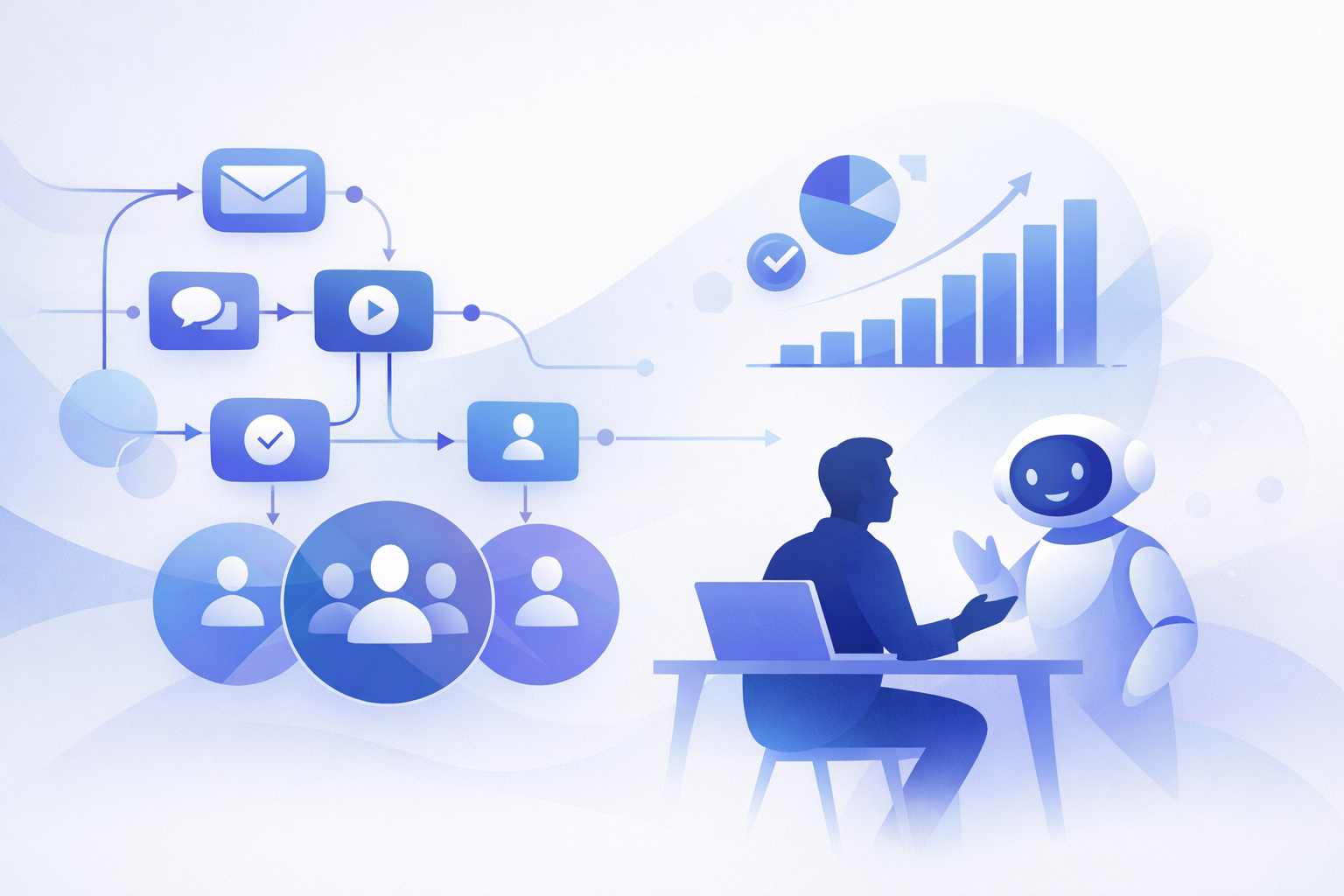
Marketing has always required a mix of creativity, timing, data, and execution. Businesses need to reach the right audience, deliver the right message, measure performance, follow up with leads, and keep campaigns moving across email, search, social media, websites, advertising, and customer journeys.
But modern marketing has become increasingly complex.
Teams are expected to create more content, manage more channels, personalize more messages, analyze more data, and prove results more clearly. For many businesses, the challenge is not a lack of marketing ideas. The challenge is managing the amount of work required to execute those ideas consistently.
AI marketing automation platforms are changing that.
Instead of relying only on manual campaign planning, static email sequences, basic segmentation, and disconnected tools, businesses can now use AI to generate campaign assets, personalize messaging, score leads, optimize timing, analyze performance, and automate parts of the marketing workflow.
These tools are not replacing marketing strategy or brand judgment. Strong marketing still requires positioning, creativity, audience insight, and clear business goals. But AI is changing how marketing teams plan, produce, personalize, and optimize campaigns.
For companies that need to do more with their marketing resources, AI marketing automation platforms have become one of the most practical uses of artificial intelligence.
What AI Marketing Automation Platforms Do
AI marketing automation platforms help businesses plan, create, manage, and optimize marketing campaigns using artificial intelligence.
At a basic level, these platforms combine automation with AI-driven insights and content support. They can help marketers create email campaigns, segment audiences, personalize messages, recommend next steps, analyze performance, and improve customer journeys.
Many AI marketing automation platforms include features such as:
- Email campaign automation
- Audience segmentation
- Lead nurturing workflows
- AI content suggestions
- Personalized messaging
- Landing page support
- Campaign performance analysis
- Lead scoring
- Customer journey mapping
- A/B testing support
- Send-time optimization
- CRM integration
- Social media campaign support
- Ad campaign recommendations
- Website personalization
- Behavioral triggers
- Predictive analytics
- Reporting dashboards
- Customer lifecycle automation
- Multi-channel campaign management
The strongest platforms are not just email tools or workflow builders. They are marketing operating systems. They help teams connect customer data, campaign execution, content creation, and performance measurement.
For example, a SaaS company might use AI marketing automation to nurture trial users into paying customers. An e-commerce business might use it to personalize product recommendations and abandoned cart campaigns. A professional services firm might use it to segment prospects by industry and send more relevant educational content. A B2B company might use AI to score leads and trigger sales follow-up when prospects show buying intent.
The real value is not simply that AI can automate tasks. The value is that businesses can run more relevant, timely, and measurable marketing campaigns.
How Marketing Automation Used to Work Before AI
Before the rise of AI marketing automation platforms, businesses used more rule-based systems.
Marketing teams would create lists, write emails, build workflows, set triggers, define segments, schedule campaigns, and review performance manually. If a prospect downloaded a guide, they might enter a prebuilt email sequence. If a customer abandoned a cart, they might receive a reminder. If a lead reached a certain score, sales might be notified.
This was useful, but it was limited.
Traditional automation depended heavily on rules that humans had to create in advance. The system could send messages, move contacts through workflows, and track behavior, but it did not deeply understand the context, quality, timing, or intent behind every interaction.
Software helped, but it did not fully solve the problem.
Businesses used email marketing tools, CRMs, analytics platforms, ad managers, landing page builders, social media schedulers, and marketing automation systems. These tools helped teams execute campaigns, but they also created complexity.
Someone still had to write all the campaign copy. Someone still had to build every workflow. Someone still had to define every segment. Someone still had to analyze the reports. Someone still had to decide what to change next.
That meant marketing automation often became powerful, but labor-intensive.
The AI revolution changed the workflow. Instead of only executing rules created by marketers, AI marketing platforms can help generate ideas, personalize content, identify patterns, and recommend improvements.
What Changed With AI Marketing Automation
The biggest change is that AI marketing automation tools make campaigns more adaptive.
A business can use AI to understand audience behavior, generate campaign content, personalize messages, recommend timing, score leads, and identify which parts of a campaign are working.
That creates several important shifts.
First, campaigns become easier to create. AI can help draft emails, subject lines, landing page copy, ads, and follow-up sequences.
Second, personalization becomes more practical. Instead of creating one message for everyone, teams can create audience-specific variations based on behavior, industry, stage, or interest.
Third, performance analysis becomes faster. AI can summarize campaign results, identify trends, and suggest improvements.
Fourth, marketing and sales can become more aligned. AI lead scoring and behavioral triggers can help sales teams focus on prospects who are more engaged or more likely to convert.
This is why AI marketing automation platforms are especially useful for businesses with repeatable campaigns, lead nurturing needs, e-commerce workflows, or complex customer journeys.
Practical Business Advantages
AI marketing automation platforms offer several practical advantages for businesses.
Faster Campaign Creation
The most obvious benefit is speed.
AI can help marketers create campaign drafts, email sequences, subject lines, ad copy, landing page sections, and social posts faster than starting from scratch.
The final campaign still needs human review, but AI can reduce the time required to move from concept to execution.
This is especially useful for small marketing teams that need to manage multiple campaigns with limited resources.
More Relevant Personalization
Personalization has always been a goal of marketing automation, but it can be difficult to execute well.
AI tools can help create variations for different customer groups, industries, buyer stages, locations, or behaviors. This allows businesses to send more relevant messages without manually writing every version from scratch.
Better personalization can improve engagement because the message feels more connected to the customer’s actual situation.
Improved Lead Nurturing
Many prospects are not ready to buy immediately.
AI marketing automation can help nurture leads over time by delivering useful content, identifying engagement patterns, and recommending when a prospect may be ready for sales outreach.
This is especially valuable for B2B companies with longer sales cycles.
Instead of treating every lead the same way, AI can help determine which prospects need education, which need follow-up, and which may be ready for a sales conversation.
Better Campaign Optimization
Marketing teams often have access to performance data, but analyzing it can be time-consuming.
AI can help summarize campaign results, identify weak points, compare audience segments, and suggest improvements. It can help marketers understand which subject lines, offers, pages, channels, or messages are performing best.
This makes optimization more continuous and less dependent on occasional manual reporting.
Stronger Sales and Marketing Alignment
AI marketing automation can help bridge the gap between marketing activity and sales action.
Lead scoring, intent signals, behavioral triggers, and CRM integrations can help sales teams understand which prospects are most engaged. Marketing can also use sales feedback to improve campaigns and content.
This can reduce wasted effort and help both teams focus on better opportunities.
Better Customer Lifecycle Marketing
Marketing does not end when someone becomes a customer.
AI automation can help businesses manage customer onboarding, retention campaigns, renewal reminders, upsell opportunities, loyalty programs, and educational content.
This is especially useful for subscription businesses, SaaS companies, e-commerce brands, and professional services firms that depend on long-term customer relationships.
Common Use Cases for AI Marketing Automation Platforms
AI marketing automation platforms are being used across many business functions.
Common use cases include:
- Email campaigns
- Lead nurturing
- Audience segmentation
- Customer journey automation
- Landing page copy
- Ad copy generation
- Social media campaign support
- Lead scoring
- CRM-triggered workflows
- Customer onboarding
- Abandoned cart campaigns
- Product recommendations
- Newsletter automation
- Event follow-up
- Webinar nurture sequences
- Re-engagement campaigns
- Customer retention
- Upsell and cross-sell campaigns
- Campaign reporting
- Performance optimization
The best use cases are usually repeatable. If a business runs recurring campaigns or manages ongoing customer journeys, AI marketing automation can make the process more efficient and more effective.
What Businesses Should Look For in an AI Marketing Automation Platform
Not all AI marketing automation platforms are the same. Some focus on email. Others focus on CRM workflows, customer journeys, e-commerce, advertising, analytics, or enterprise marketing operations.
When comparing providers, businesses should look at:
- Email automation features
- CRM integration
- Audience segmentation
- AI content generation
- Brand voice controls
- Lead scoring
- Workflow builder quality
- Behavioral triggers
- Personalization options
- A/B testing support
- Reporting and analytics
- Customer journey mapping
- Social and ad integrations
- E-commerce integrations
- Data privacy controls
- Team permissions
- Approval workflows
- Ease of use
- Scalability
- Pricing structure
- Enterprise support
Businesses should also look for transparency. AI-generated recommendations should be understandable. Marketers need to know why a segment, message, or lead score is being recommended.
Where AI Marketing Automation Fits in the Future of Business Growth
AI marketing automation platforms are becoming part of the modern growth stack.
In 2026, businesses are likely to use AI across campaign planning, content production, audience segmentation, customer journey management, and performance analysis.
But the companies that benefit most will not be the ones that automate everything without strategy. They will be the ones that use AI to improve relevance, timing, and execution.
They will use AI to create campaigns faster. They will use AI to personalize messages more effectively. They will use AI to understand performance more clearly. They will use AI to connect marketing activity with sales outcomes. They will use AI to communicate with customers throughout the full lifecycle.
That is where the real business value is.
Final Thoughts
AI marketing automation platforms are helping businesses move beyond the old limits of manual campaign management and rule-based workflows. They make it easier to create campaigns, personalize communication, nurture leads, analyze results, and manage customer journeys at scale.
The value is not just automation. The value is smarter marketing execution.
Businesses need to reach the right audience. They need to send relevant messages. They need to follow up consistently. They need to understand what is working. They need to connect marketing with sales. They need to turn attention into measurable growth.
AI marketing automation platforms help make that possible.
That is why this category has become one of the most important areas of practical AI adoption for modern businesses.
Build accurate target lists, enrich and score them, and reach the right contacts without turning outreach into spam.
Keep reading
- AI Education & Training ToolsPluralsight Introduces AI Learning Integrations and Skill Development Tools
- AI Cybersecurity ToolsSecuronix Introduces Agent Behavioral Analytics to Monitor Autonomous Systems
- AI Healthcare Technology ToolsGenie Health Secures Seed Capital to Expand AI-Driven Digital Healthcare Solutions
- AI Coding & Developer ToolsSimplismart In Talks for New Investment Round to Expand AI Infrastructure
- AI Research ToolsAlbert Invent Advances AI for Chemical Experimentation
- AI Cybersecurity ToolsSophos Introduces AI Defense for Real-Time Security and Shadow AI Detection